GlyphGlance

VERSION 1.5 / Mac + iPhone + iPad / FREE

Your documents.
Wherever you are.

Markdown, Mermaid diagrams and Fountain screenplays, beautifully in view. GlyphGlance 1.5 brings the reader you know to iPhone and iPad, including iPhone Duo. Read, navigate, copy and export in six languages. Your original file stays untouched.

What’s new in 1.5 ↓

Available free on the App Store. Requires an Apple silicon Mac with macOS 26 or later, or an iPhone or iPad with iOS or iPadOS 26 or later. Includes adaptive layouts for iPhone Duo.

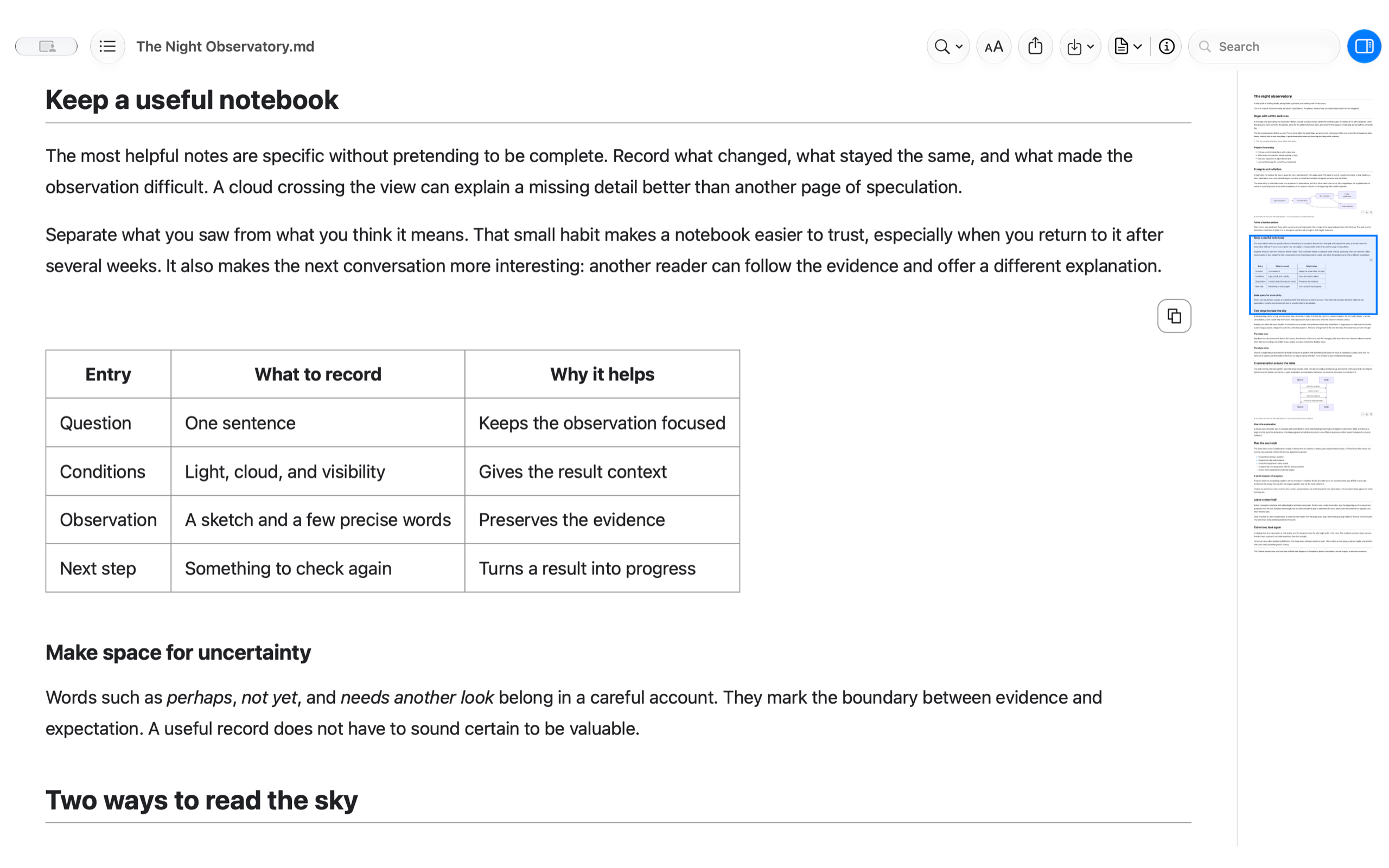
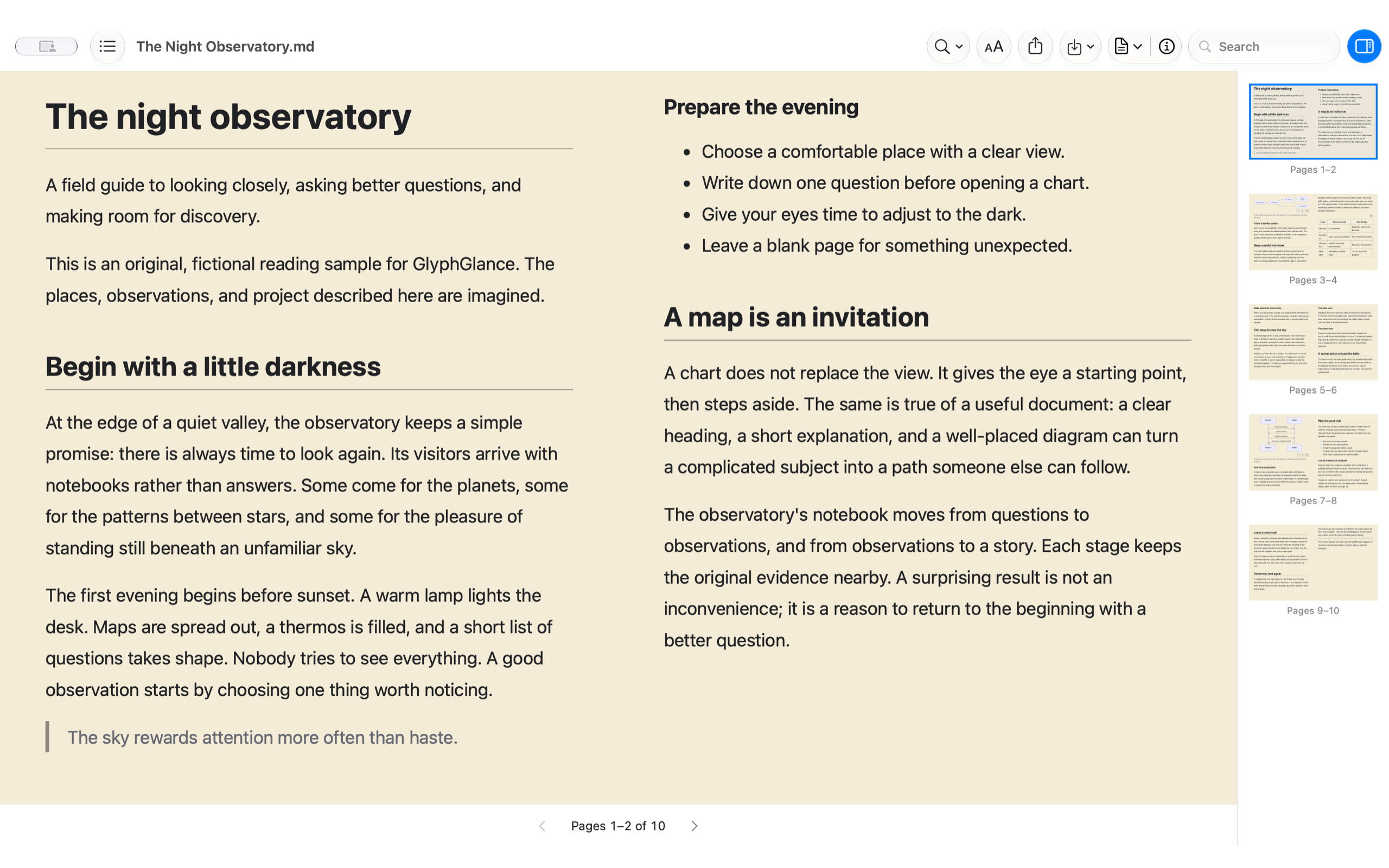
GlyphGlance 1.5 on Mac with sepia two-page reading and spread thumbnails.
GlyphGlance 1.5 / Mac From the App Store submission, captured October 30, 2026. Click to explore.

NEW IN 1.5 / AVAILABLE NOW

A familiar reader.
More places to read.

One free reader, from your Mac to your pocket. GlyphGlance 1.5 is available for macOS and iOS, with native experiences for iPhone, iPad and iPhone Duo.

Made for your screen.

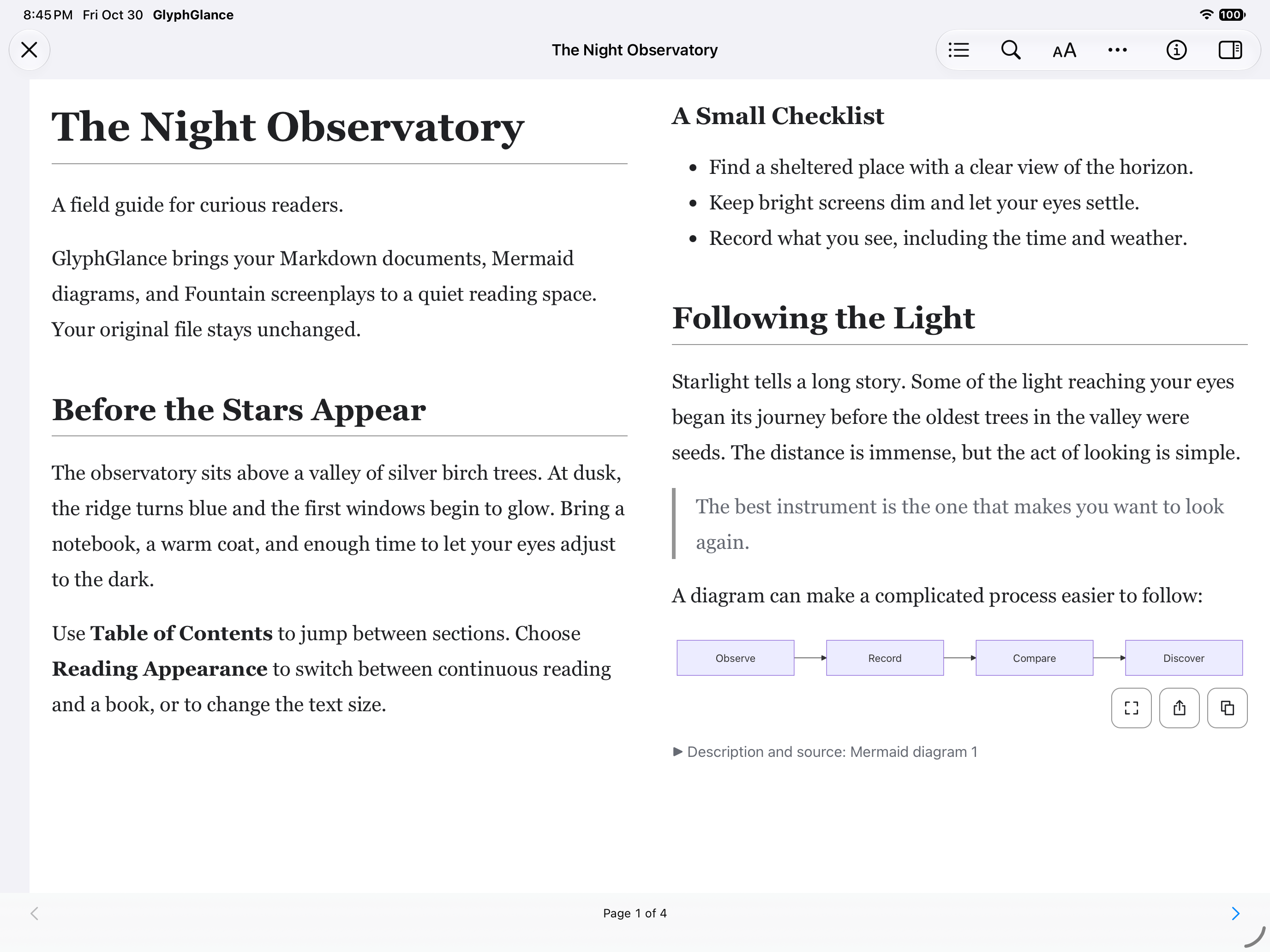
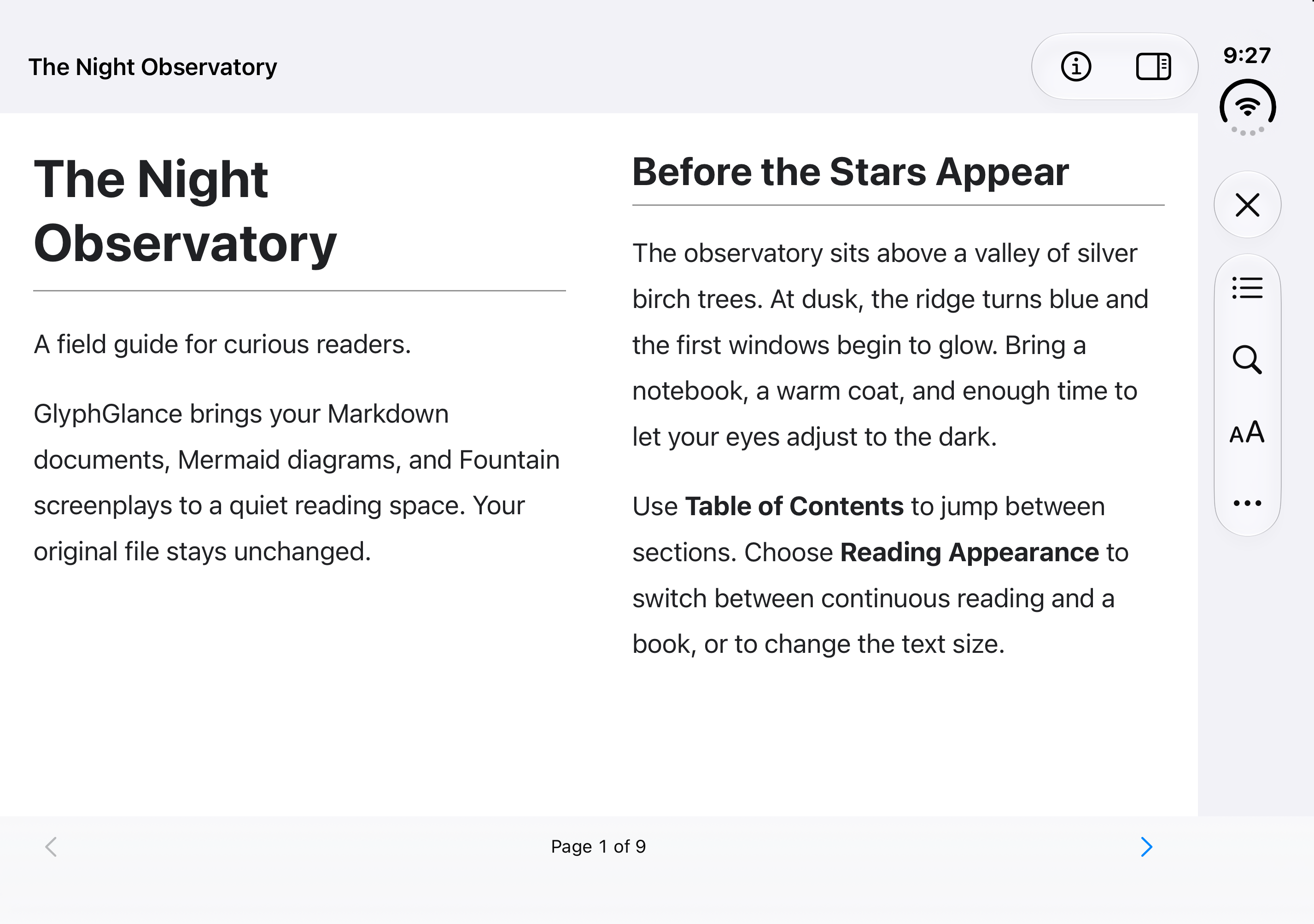
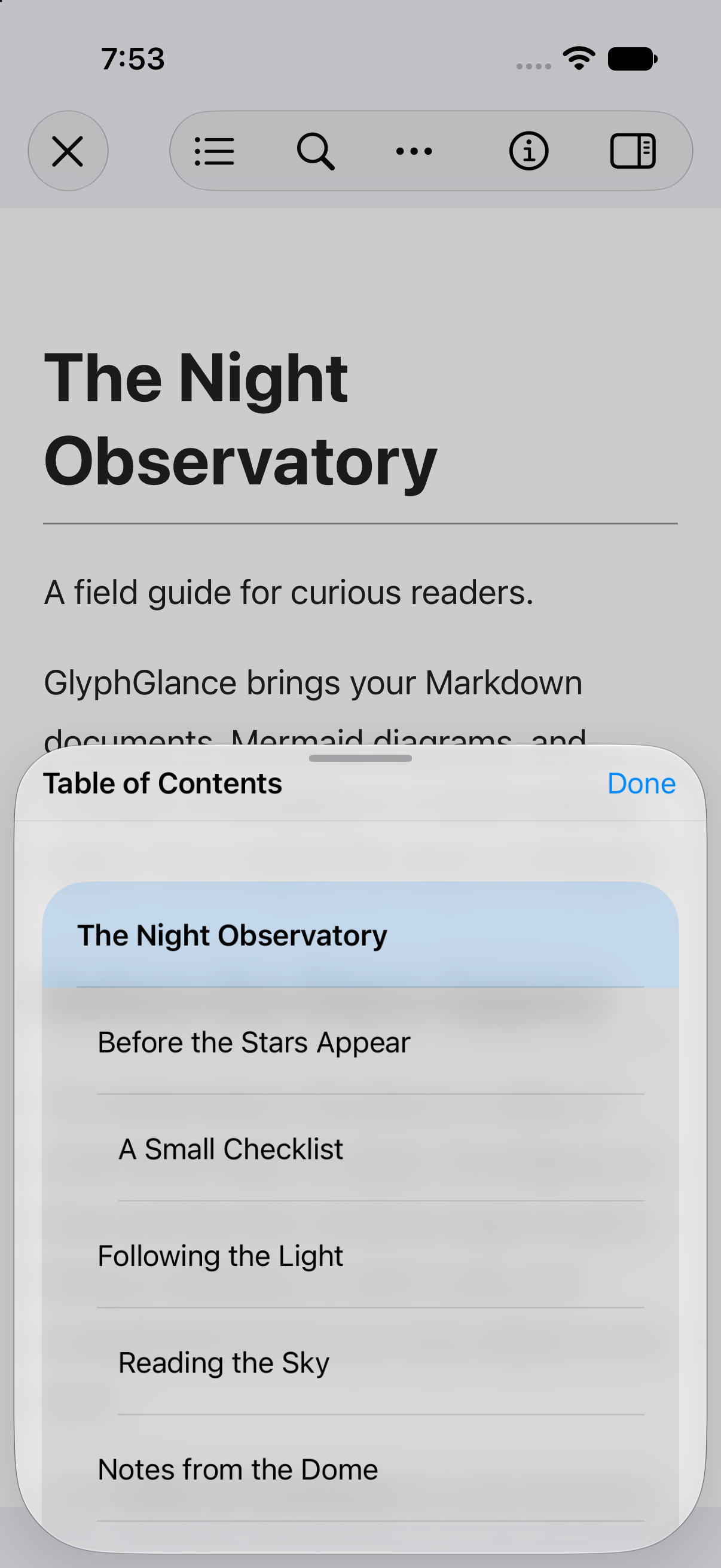
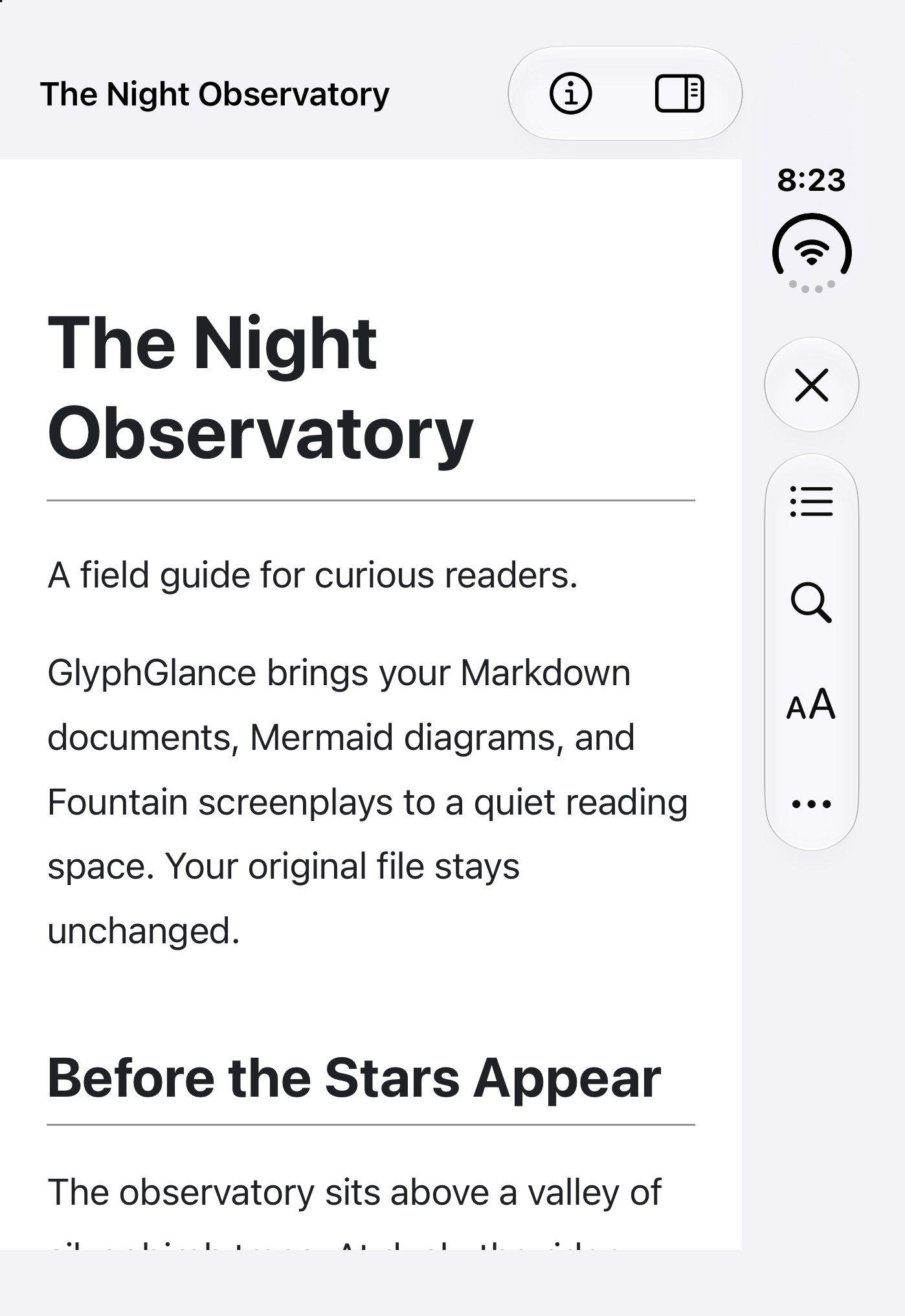
Open documents from Files and iCloud Drive on iPhone and iPad. Swipe through pages, explore diagrams with touch, and move between a compact Overview overlay and a spacious sidebar. iPhone Duo adapts as the available reading area changes.

Read it. Copy it. Reuse it.

Copy code with indentation and line breaks intact. Copy a complete table into Excel or Numbers, even when a narrow reader presents it as labeled rows. Export PDF or Word, share, print and use Shortcuts.

Your place. Your language.

Choose continuous reading, pages or a two-page spread when space allows. Use the app and Help in English, German, French, Spanish, Hindi or Simplified Chinese. Mobile reading positions are saved on this device; they do not sync between devices.

Choose your website language for matching Help. The Mac and mobile guides use the released app’s own translated topics and control names.

FINDER QUICK LOOK ON MAC

Select a file.
Press Space.

Read a README, review an architecture note, or inspect a research write-up directly in Finder. Supported diagrams, formulas, and highlighted code appear alongside the explanation.

  1. Enable the extension.

    Turn on GlyphGlance Quick Look in macOS System Settings. If another Markdown preview extension takes priority, you may need to disable that competing extension.

  2. Choose your document.

    Select a supported Markdown, Mermaid, or Fountain file in Finder.

  3. Take a closer look.

    Press Space to read the inline preview. Open the document in GlyphGlance for search, enlarged diagrams, and PDF or Word export.

READING ON MAC, YOUR WAY

A little less around you.
More room for the idea.

Make reading your own, from a quiet page to the right font, spacing, and color. Your choices change the view, while the original document stays exactly as it was.

01

Hide the distractions.
Keep your place.

Enter Reading Mode with Shift–Command–R to hide the main toolbar and Info sidebar. Contents, Reading Appearance, and Overview stay available at the top, alongside search, text selection, links, diagrams, and Read Aloud. Leave Reading Mode to restore your previous presentation.

Optionally enter native full screen and restore the previous window when you leave. This setting is off by default. Reading Mode is available in the app, rather than Finder Quick Look. Read the Reading Mode guide.

02

Your font.
Your reading rhythm.

Choose System, Georgia, Palatino, Verdana, or bundled offline OpenDyslexic. Adjust text size, line spacing, indents, alignment, and margins. Fit Window follows the window width; Readable Column limits the line length.

Save defaults in Settings or adjust one window with Reading Appearance. Changes apply live to open documents, including outside Reading Mode. Quick Look, PDF and Word exports, and shared diagrams keep their own formatting. Explore typography and layout.

03

A familiar appearance.
A page of your own.

Choose System, Light, or Dark appearance independently of Default, Sepia, Gray, or Custom page themes. Custom themes retain separate light and dark backgrounds, while text and interface colors adapt for contrast.

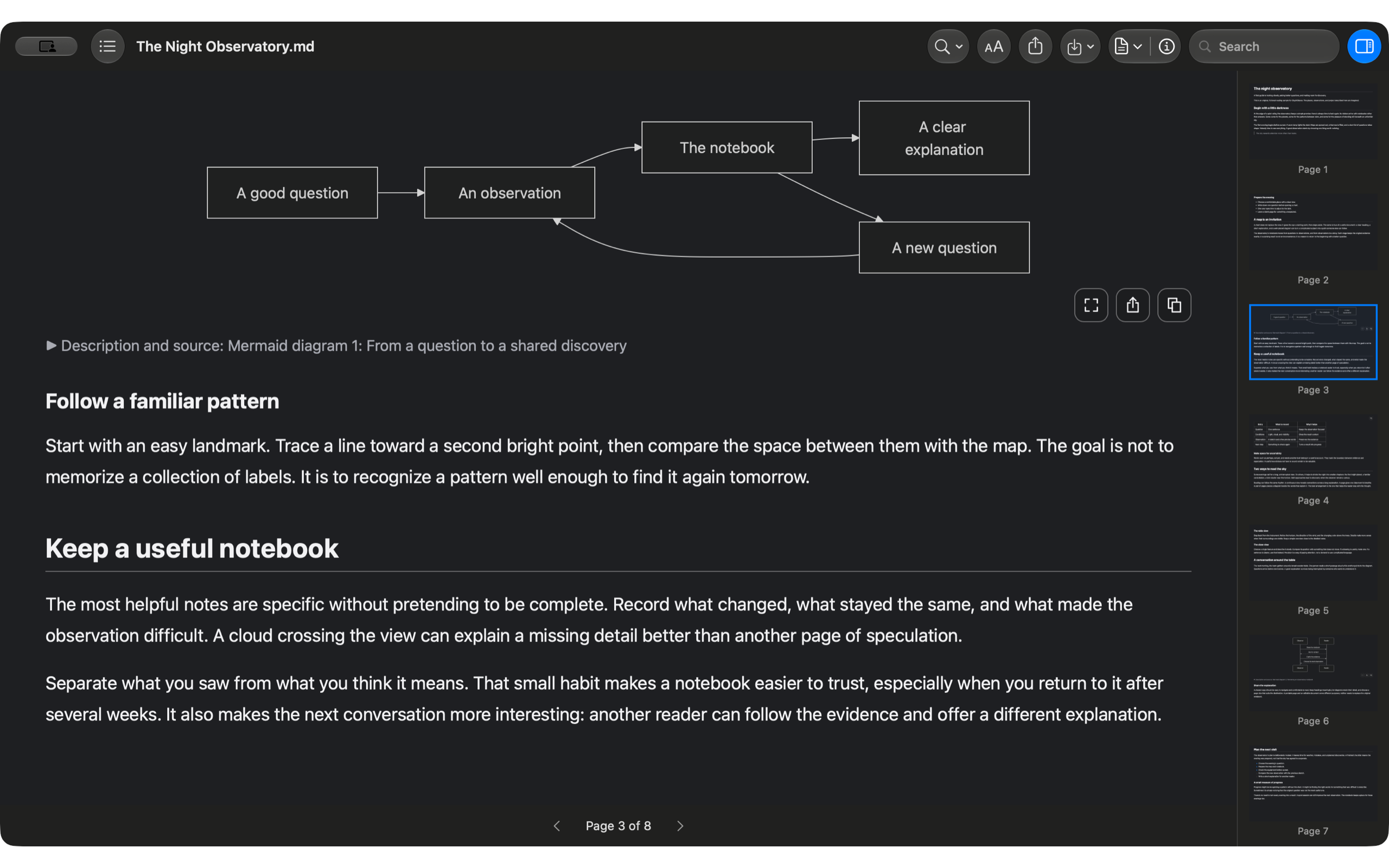
Mermaid canvases follow the page background while preserving authored diagram colors. These choices affect GlyphGlance’s reading window; your global macOS appearance stays as you set it. Find your appearance.

The familiar Mac reader retains adjustable typography, page themes, Reading Mode, responsive text width, diagram sharing and optional on-device metadata. Version 1.5 adds code and table copying and more readable tables in narrow views.

THE SAME DOCUMENT, A DIFFERENT LIGHT

Settle into
your own view.

Follow macOS automatically, or choose a Light or Dark reading window. Give the page a warm sepia palette, neutral gray, or custom colors without changing your font or layout.

Use Reading Appearance for temporary adjustments to one window. Choose Use Saved Preferences to reconnect it to your defaults.

Make it comfortable

GlyphGlance 1.5 on Mac showing Mermaid diagrams in Dark reading appearance.
Mac / Dark reading From the 1.5 App Store submission.

READ IT. REUSE IT.

See the connections.
Keep the context.

Take the next step with what you read: reuse an editable document, share the diagram that explains it, or review a locally generated summary before exporting.

01

From Markdown
to editable Word.

Export .docx files with native heading styles, editable lists and tables, links, and common mathematical equations. Mermaid diagrams stay sharp as SVG vectors, with compatibility images for older readers.

Word controls reflow and pagination. Diagrams are graphics, rather than editable flowchart shapes. Explore Word export.

02

One diagram.
Ready to travel.

Share an individual Mermaid diagram as SVG or a PDF page fitted to the graphic. Copy offers SVG and PDF alongside PNG and TIFF alternatives for compatible apps and clipboard managers.

Enlarge a diagram in a separate display-sized view. Finder Quick Look keeps the inline preview; Share, Copy, and enlargement controls are available in the app. Read the diagram guide.

03

A little context.
Generated on your Mac.

When Apple Intelligence’s on-device model is available for the document language, Info can show a generated subject and short summary. PDF and Word exports can include them too. Author attribution requires an explicit source byline.

Generation stays on your Mac. AI descriptions can be inaccurate; review them before sharing. Reading and export still work when the model is unavailable. How metadata works.

04

A sharp PDF.
A clear path through it.

Export paginated PDFs with selectable, searchable text and a heading-based contents outline. Mathematics and Mermaid diagrams remain vector content wherever possible; source bitmap images remain images.

Supported document structure, language, and authored descriptions are retained. Your reading zoom doesn’t change the exported layout. Read the PDF guide.

05

Find your place.
Pause when you need.

Search rendered text with Command–F, zoom to fit, inspect file details, and customize the native toolbar. Pause and resume Read Aloud when you need a break. On macOS 27, control the active reading through Now Playing.

Speech uses your system voice and speaking preferences. Set up Read Aloud.

06

Your source stays
exactly as it was.

Read, change the preview profile, enlarge a diagram, or export without editing the original file. Rendering happens locally using bundled resources, with no in-app account or hosted rendering service.

Supported local content works offline. Remote resources are blocked, and document HTML is shown as text rather than executed.

07

Bring reading into
your workflow.

On Mac, use Preview File, Export as PDF, Export as Word, and Get Document Information through native Shortcuts actions. An optional local MCP service offers the same operations to compatible clients, within the document and export folders you explicitly allow.

MCP is off by default, has no network listener, and never overwrites an existing export. Clients control their own use of returned content. Read the automation guide.

NOTATION, IN CONTEXT

The formula.
The code.
The whole idea.

Read inline and display mathematics from supported LaTeX-style syntax, with syntax highlighting for fenced code blocks. Keep the reasoning next to the implementation.

Explicit language tags help GlyphGlance choose the right highlighting for your examples.

GlyphGlance 1.5 on Mac showing mathematics, highlighted Swift code and its Copy control.
Mac / Mathematics and code From the 1.5 App Store submission.

A FAMILIAR FILE, A FRESH VIEW

Made for the documents
you already have.

Automatic profile selection handles ordinary use. Choose a different Markdown profile for the current window when you need it, including CommonMark, GitHub Flavored Markdown, MultiMarkdown, Pandoc, Markdown Extra, Original Markdown, and RFC-oriented previews.

.md.markdown.mdown.mkd.mkdn.mermaid.mmd.fountain

Ambiguous .mmd files are checked for Mermaid content and otherwise previewed as MultiMarkdown. Fountain screenplay previews are also supported. Syntax support varies by profile.

Is GlyphGlance free?

Yes. GlyphGlance 1.5 is a free reader for Mac, iPhone and iPad from Obscure Essentials®. The Help area explains Reading Mode, appearance and typography, diagram sharing, speech, PDF and Word export, AI metadata, and automation.

Which devices can run it?

GlyphGlance 1.5 supports Apple silicon Macs with macOS 26 or later, and iPhone and iPad with iOS or iPadOS 26 or later, including iPhone Duo. Intel Macs are not supported.

Can I edit my document in GlyphGlance?

GlyphGlance is a read-only viewer. Reading, selecting a preview profile, enlarging diagrams, and exporting do not change your source file. Use your preferred editor when you want to make changes.

Do my reading preferences change Quick Look or exports?

No. Fonts, spacing, margins, appearance, and themes affect GlyphGlance’s document windows. Finder Quick Look, PDF and Word exports, and shared or copied diagrams keep their own formatting. Your source file stays unchanged.

What happens when I share a document?

The document toolbar’s Share control shares the original file. Export PDF or Word when you want to share a converted document; a diagram’s own Share and Copy controls transfer only that graphic. The destination app chooses among the supplied formats and has its own privacy practices.

Does GlyphGlance require Apple Intelligence?

No. Reading, Finder Quick Look, and export work without it. Optional subject and summary generation requires Apple Intelligence to be enabled, its on-device model to be ready, and a supported document language. If generation is unavailable, export continues without those optional fields.

Does PDF export preserve accessibility information?

Exports retain supported document structure tags, content language, and authored image or diagram descriptions. This supports accessible reading, but is not PDF/UA certification or a guarantee that every source document is accessible.
Questions?
Talk to the maker.

Need help with a document or have an idea for GlyphGlance? Get in touch with Sascha.